Hello everybody, welcome to our recipe site, If you're looking for new recipes to try this weekend, look no further! We provide you only the perfect Stronger Bread Starter By Increasing the Yeast Content recipe here. We also have wide variety of recipes to try.
Before you jump to Stronger Bread Starter By Increasing the Yeast Content recipe, you may want to read this short interesting healthy tips about Healthy Eating Can Be An Easy Choice.
Making the decision to eat healthily offers many benefits and is becoming a more popular way of life. Poor diet is a contributing factor in illnesses such as heart disease and high blood pressure which can place a drain on the economy. There are more and more efforts to try to get us to follow a healthier way of living and still it is also easier than ever to rely on fast, convenient food that is not good for our health. In all probability, a lot of people assume that it takes too much work to eat healthily and that they will have to drastically change their way of life. In reality, though, just making a few small changes can positively impact everyday eating habits.
The first change to make is to pay more attention to what you buy when you shop for food since it is likely that you tend to pick up many of the things without thinking. For example, has it crossed your mind to check how much sugar and salt are in your favorite cereal? A good healthy option can be porridge oats which have been found to be beneficial for your heart and can give you good sustainable energy each day. Add fruits or spices to improve how the oatmeal tastes and now you have a breakfast that can be a regular part of your new healthy diet.
As you can see, it’s not at all difficult to start integrating healthy eating into your daily routine.
We hope you got insight from reading it, now let’s go back to stronger bread starter by increasing the yeast content recipe. To make stronger bread starter by increasing the yeast content you need 10 ingredients and 26 steps. Here is how you do it.
The ingredients needed to make Stronger Bread Starter By Increasing the Yeast Content:
- Provide 110 grams Raisins (not coated with oil or wax)
- Get 210 grams Water (domestic natural spring water) or boiled and cooled water
- Get 40 grams Sugar
- Prepare 1 A plastic or glass jar without a lid
- Prepare 1 piece Paper towels and a rubber band or aluminium foil
- You need To extend a previously made starter
- Take 100 grams Raisins (not coated with oil or wax)
- Take 200 grams Water
- Use 40 grams Sugar
- Prepare 10 grams Raisin starter
Instructions to make Stronger Bread Starter By Increasing the Yeast Content:
- If the starter is exposed to air, it'll deplete the sugars and build up carbon dioxide. If it's not exposed to air, it'll start fermenting and produce alcohol.
- If you want to let the yeast grow, it needs air to grow, thus don't cover your starter with a lid! That's the logic behind the instructions.
- If you want to make a strong and active raisin starter, use a wide-mouth container so that comes into plenty of contact with air. Don't cover it with a lid, cover with paper towels or foil instead, and increase the number of times you mix it up. That alone makes all the difference.
- Don't wash the raisins. If you are using tap water, filter it or use boiled and cooled water. If you use straight tap water, the starter may become acidic, so use soft water like spring water.
- Don't wipe your starter container with a kitchen towel before use. If it has water droplets after washing it, it's fine. Sterilize the spoon mix the starter in boiling water.
- Wash all of your equipment well using detergent, but don't wipe with a kitchen towel as the towels may have bacteria on it.
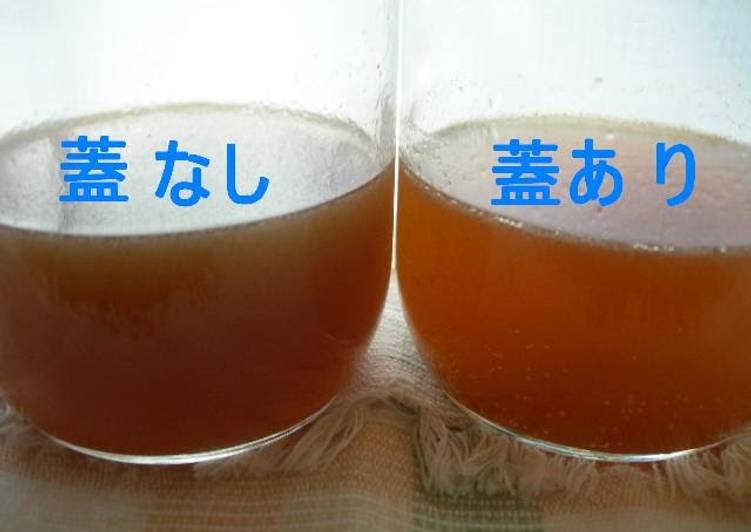
- Here I made two batches of starter at once to demonstrate the theory, but just make the lidless version.
- How to make the starter: Put the sugar and water that has been warmed up to about 30°C in the container and dissolve the sugar. Add the raisins.
- Start the experiment! As you can see, the one on the left is covered with a lid. The one on the right has no lid. Both have the same amount of ingredients.
- If doing this at room temperature: Put the starter jars in a warm place, and mix them up twice a day. The ideal room temperature is 26 to 30°C.
- Day 2: The raisins are rising to the surface. You can see some fine bubbles in the lidded one. In the lidless one you can see big bubbles.
- Day 4: The lid-covered one has lots of bubles! The lidless one has about the same amount of bubbles. The liquid in the lidless one is a bit darker.
- Day 5: The raisins are floating above the surface of the lid-covered on, and the liquid is foaming. If you mix it up, the foam increases and the liquid gets more cloudy.
- The lidless one has a sweet-tart aroma and no detectable alcohol smell.
- If you mix it up and look at it from the side, it has some fine bubbles. Strain off the raisins from both versions, and store in the refrigerator.
- The left one is the lidless version, and the right one is the lidded version. The lidded version has a lighter, prettier color, and foams up like beer. The lidless version is cloudier and darker!! And when you mix it up, it stays quiet. It also tastes stronger, and has way more yeast!! Both are done.
- Store them both covered. While they are stored in the refrigerator, open them up at least twice a month to expose it to air. Use within a month.
- When there is only a little starter left, using the "extend" amounts to keep them going. You can keep them alive for years. Add 1 teaspoon of sugar once a month and store.
- How to make the starter extension: The temperature to aim for for the raisin starter is 25 to 30°C.
- Use your existing starter liquid as the mother. Put 30°C water in a clean container, add sugar and dissolve, then add the raisins and the mother starter. Cover with paper towels.
- Put the container in a warm location. Observe its progress, using the photos on this page as reference.
- You can use the raisins used to make starter mixed into dough to make bread.
- If you use raisins to make starter, you shouldn't get mold. Raisins contain a powerful anti-fungal agent called propionic acid.
- Raisin bread does not mold easily. If mold does occur, there are probably other reasons.
- If something called acetic acid bacteria develops, a white film will develop on the surface of the liquid, and it will smell bad.
- If that happens, just throw the starter out and try again If you introduce as much oxygen as possible, you can avoid this.
If you find this Stronger Bread Starter By Increasing the Yeast Content recipe valuable please share it to your good friends or family, thank you and good luck.